| Viriditas is the major thread connecting Hildegard of Bingen's life and work. The concept refers to the life force in nature and in salvation history, in a cycle of birth, life, death, and rebirth. Building on Ryszard Sadowski's Christian models of human relations with nature, I begin with viriditas in the gardens that preceded Hildegard. These gardens include biblical gardens, ancient gardens, the gardens of the early saints, and the gardens of the Carolingian Era. In the Bible, the Garden of Eden is a custodial model garden that represents paradise and humankind's fall. The nuptial model garden in the Song of Songs is a metaphor for divine love, while Gethsemane symbolizes Christ's Redemption. The gardens of the ancient Greeks and Romans provide basic form and content, and the Celtic gardens demonstrate an animate model of care for the earth. The gardens of the medieval Christian saints symbolize prayer, work, and virtue. I show how Hildegard's own healing gardens are rooted in these models, especially in the Benedictine custodial garden model as documented from the ninth century Plan of St. Gall and the lyric poem, Hortulus, by monk and theologian, Strabo. Hildegard's vegetables and herbs are part of the great garden tradition of natural health and healing, as manifest in her collected medical works, Physica and Causae et curae, and presented in original words in her created language, Lingua ignota.
Gardens set the stage for Hildegard's concept of viriditas in her theological writing, poetry, music, and art. Her work is a manifestation of divine inspiration, and her multisensory approach to viriditas offers the learner abundant and varied ways of knowing God. Hildegard's life of visions is detailed through her life as a Benedictine nun in the Disibodenberg and Rupertsberg Monasteries and in her creative expression. Her three books, Scivias (1141-1151), Liber vitae meritorum (1158-1163), and Liber divinorum operum (1163-1173), are based on her visions, and the concept of viriditas is elaborately expressed in Hildegard's sacred songs compiled in the Symphonia armonie celestium (1158) and Ordo virtutum (1151). I analyze four illuminations from Scivias, four illuminations from Liber divinorum operum, and three songs from Symphoniae that foreground themes of viriditas and the garden in visual art, poetry, and music. Hildegard invites all of humankind to become viriditas saints. |
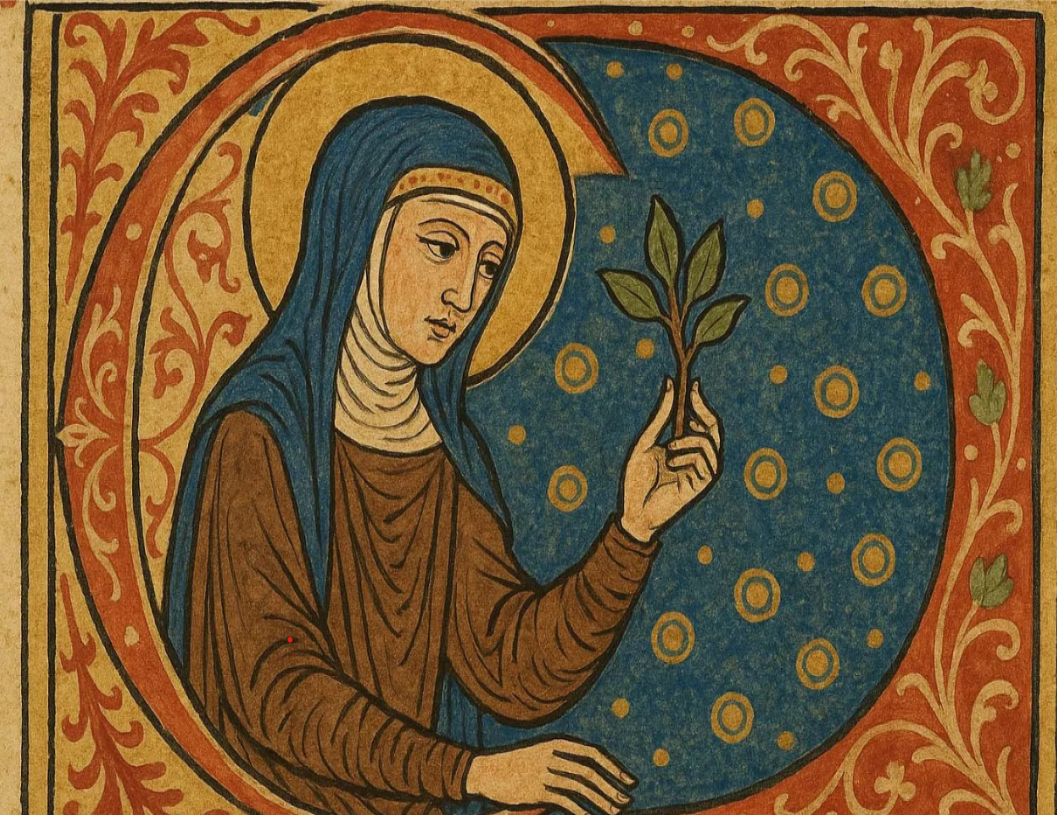
H. Jochen Schenk. "Hildegard von Bingen: Science in the Middle Ages: A Purpose-driven View of Plants." The Plant Connection (2025). |